Warehouses are among the highest-risk commercial facilities in Australia. Storing thousands — sometimes millions — of dollars worth of inventory, equipment, and sensitive goods, they are prime targets for theft, vandalism, and unauthorized access. In Melbourne’s growing industrial and logistics corridors — from Sunshine North and Truganina to Dandenong and Laverton North — warehouse operators face a constant security challenge that demands professional, licensed protection.
Yet many businesses are still unclear about what a warehouse security guard actually does day to day. Is it just standing at a gate? Watching CCTV screens? The reality is considerably more involved — and understanding the full scope of duties and responsibilities is critical whether you are hiring a security guard company in Melbourne or managing one.
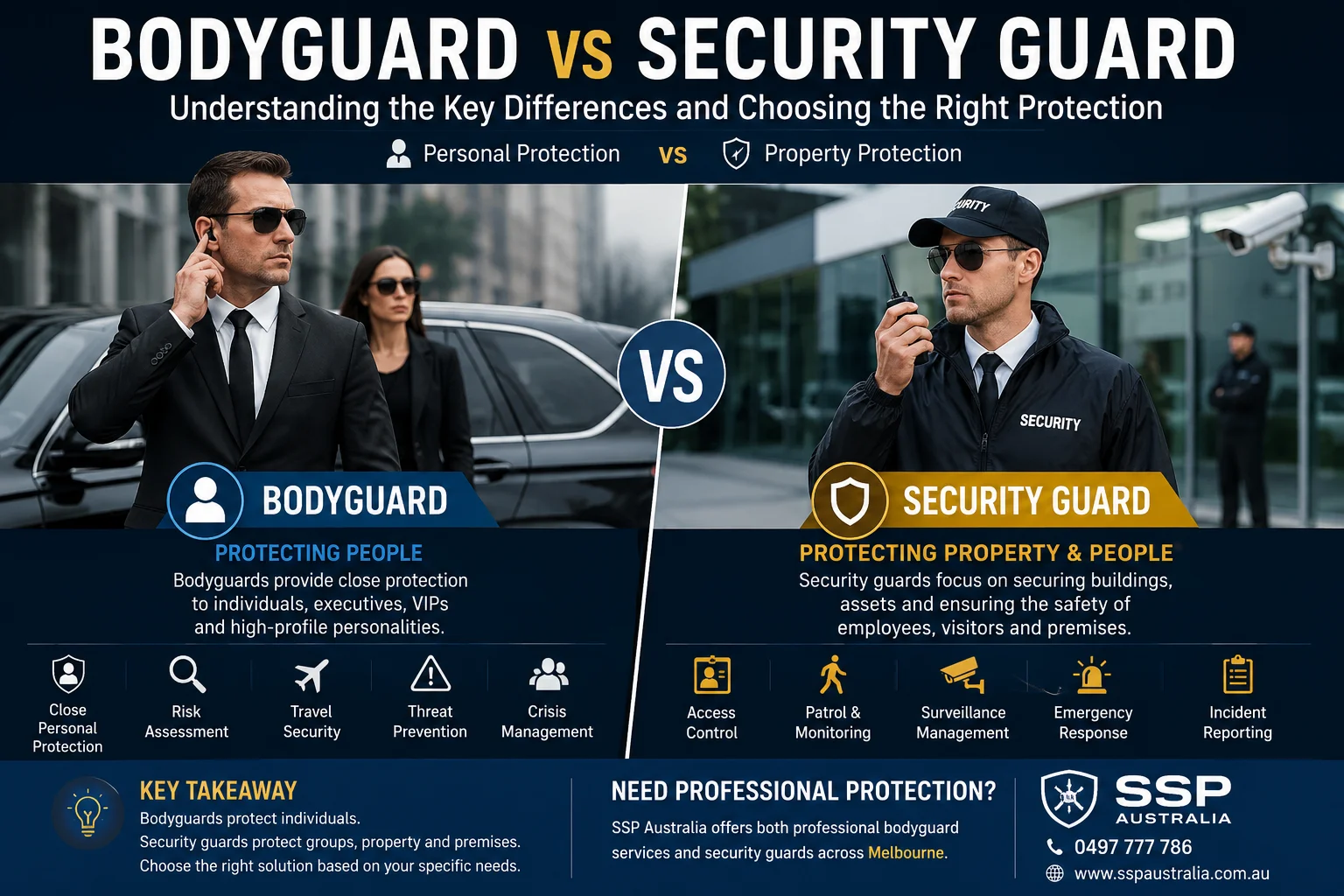
In this guide, SSP Australia — a Victoria Police licensed security company with 15+ years operating across Melbourne and Greater Victoria breaks down every key duty and responsibility of a security guard in a warehouse environment.
Why Warehouses Need Dedicated Security Guards
Before diving into specific duties, it is worth understanding why warehouses demand specialist security attention rather than generic protection. Warehouse environments present a unique combination of risk factors that distinguish them from offices, retail environments, or residential properties.
Warehouses typically operate across large, complex floor plans with multiple entry and exit points, vehicle access areas, loading docks, and storage zones — many of which are difficult to monitor without a physical presence. They often operate during extended hours, including overnight shifts when risk is highest and staff numbers are lowest. High-value inventory — electronics, pharmaceuticals, consumer goods, construction materials — creates a persistent theft risk from both external intruders and internal staff.
According to industry data, cargo theft and warehouse shrinkage remain significant problems for Australian businesses, with supply chain disruptions causing both direct financial losses and reputational damage. Professional warehouse security guards are the most effective first line of defence against these risks.
Core Duties and Responsibilities of a Warehouse Security Guard
While every warehouse has unique requirements based on size, location, industry, and risk profile, there are core duties that all professional warehouse security guards are expected to perform. Here is a detailed breakdown.
Duty 01
Access Control and Identity Verification
Access control is the foundation of warehouse security. A security guard’s primary responsibility at any warehouse is ensuring that only authorised personnel, vehicles, and contractors can enter the facility at any time.
This involves:
- Checking employee identification badges, key cards, and visitor passes
- Verifying the identity and purpose of contractors, delivery drivers, and vendors
- Logging all authorised entries and exits with time-stamped records
- Operating and managing electronic access control systems including biometric scanners and swipe-card readers
- Preventing tailgating — the practice of unauthorised individuals following legitimate personnel through secured access points
- Managing vehicle access at loading docks and gates, ensuring all trucks and delivery vehicles are authorised before entry
Effective access control not only prevents external intruders but also reduces the risk of internal theft — a significant contributor to warehouse shrinkage across Melbourne’s logistics sector.
Duty 02
Regular Site Patrols
Scheduled and random patrols are a critical component of warehouse security. Guards conduct systematic walkthroughs of the entire warehouse — interior zones, perimeter fencing, loading docks, parking areas, and roof access points — checking for security vulnerabilities, suspicious activity, or safety hazards.
Patrols serve multiple functions:
- Visible deterrence — a patrolling guard significantly reduces the likelihood of opportunistic theft or vandalism
- Early detection — identifying unlocked doors, broken perimeter fencing, tampered CCTV cameras, or unusual activity before incidents escalate
- OHS compliance — spotting and reporting safety hazards such as spilled chemicals, exposed wiring, or unsecured fire exits
- Shift handover documentation — recording patrol findings in daily activity logs for management review
For larger warehouse facilities across Melbourne, mobile patrol security using GPS-tracked patrol vehicles can supplement or replace static patrols — covering greater ground area at lower cost while maintaining comprehensive site oversight.
Duty 03
CCTV Surveillance Monitoring
Modern warehouse security relies heavily on closed-circuit television (CCTV) systems, and security guards are responsible for actively monitoring these systems — not just having them installed. Passive CCTV without a monitoring presence is a significantly weaker deterrent.
A warehouse security guard’s CCTV responsibilities include:
- Continuously monitoring live camera feeds across all warehouse zones, including blind spots and high-value storage areas
- Identifying and responding to unusual activity captured on camera in real time
- Ensuring all cameras are functioning correctly and reporting technical faults promptly
- Reviewing recorded footage following an incident or security breach
- Conducting environmental analysis to identify surveillance blind spots and recommend additional camera placement to management
Duty 04
Loss Prevention and Inventory Protection
Warehouse theft — whether by external parties or internal employees — is a persistent challenge for Melbourne logistics and distribution businesses. Security guards play a direct role in loss prevention through both visible deterrence and procedural oversight.
Loss prevention duties include:
- Monitoring and inspecting outgoing shipments at loading docks to verify goods match documented dispatch records
- Conducting random checks of vehicles leaving the warehouse premises
- Assisting in stock audits and inventory verification processes
- Identifying and reporting patterns of suspicious behaviour that may indicate internal theft or organised external activity
- Escorting contractors and visitors through high-value or restricted inventory zones
Duty 05
Emergency Response and Incident Management
Warehouse security guards are the first responders to any emergency on site — before police, fire, or ambulance services arrive. Their ability to respond quickly and calmly in high-pressure situations can be the difference between a contained incident and a major crisis.
Emergency response responsibilities include:
- Immediately contacting emergency services (000) and relevant management personnel upon detection of a fire, medical emergency, break-in, or other critical incident
- Coordinating safe and orderly evacuation of all staff and visitors in accordance with the warehouse’s emergency procedures
- Providing basic first aid until ambulance personnel arrive — all SSP Australia guards hold current first aid certification
- Controlling and securing the perimeter during and after an incident to prevent further intrusion or evidence tampering
- Liaising with Victoria Police, fire brigades, and paramedics on arrival and providing factual incident summaries
- Managing hazardous materials incidents — particularly relevant in warehouses storing flammable, chemical, or pharmaceutical goods
Duty 06
Incident Reporting and Daily Logs
Accurate and detailed documentation is a non-negotiable professional standard for all licensed security guards in Victoria. Every shift, every incident, every observation — documented.
Documentation duties include:
- Maintaining a daily activity log (DAL) recording patrol times, access control activities, and any notable observations throughout each shift
- Writing detailed incident reports for any security breach, theft, accident, or emergency — including time, location, description, persons involved, and actions taken
- Preparing shift handover briefings to ensure continuity of security coverage between guard rotations
- Providing documentation to Victoria Police or management for any incidents requiring investigation or legal follow-up
- Identifying trends in incident reports to help management improve security protocols and infrastructure
Duty 07
Loading Dock and Vehicle Traffic Management
Melbourne’s major warehouse and distribution hubs handle significant volumes of inbound and outbound freight daily. Loading docks are among the highest-risk areas in any warehouse — they represent a primary entry and exit point for both legitimate goods and potential theft.
Guards stationed at or patrolling loading docks are responsible for:
- Verifying the identity and authorisation of all delivery drivers, transport companies, and freight contractors
- Ensuring loading dock gates and roller doors are secured when not in active use
- Managing vehicle traffic flow to prevent congestion, accidents, and unauthorised parking
- Supervising the loading and unloading of high-value or sensitive cargo
- Cross-checking delivery manifests against actual deliveries to identify discrepancies
Duty 08
Occupational Health and Safety (OHS) Support
Under Victoria’s Occupational Health and Safety Act 2004, employers have a duty of care to maintain a safe working environment. Security guards actively support this obligation by identifying and reporting hazards as part of their regular patrol duties.
OHS-related security responsibilities include:
- Identifying and reporting physical hazards — spills, damaged racking, exposed electrical wiring, and obstructed fire exits
- Monitoring and enforcing PPE (personal protective equipment) compliance in designated warehouse zones
- Reporting any safety rule violations by staff, contractors, or visitors to warehouse management
- Ensuring emergency exits remain unobstructed and fire extinguishers are in place during patrol checks
Qualities That Make an Effective Warehouse Security Guard
Beyond the formal duties listed above, the best warehouse security guards bring a set of personal qualities that make the difference between adequate protection and genuinely excellent security. When hiring warehouse security guards in Melbourne, look for candidates and companies that demonstrate:
- Attention to detail — the ability to notice subtle changes in a warehouse environment that may indicate a security concern
- Physical fitness — warehouse patrols require sustained walking across large, often multi-level facilities, sometimes for extended overnight shifts
- Integrity and honesty — particularly important in environments where guards themselves have access to high-value inventory
- Calm under pressure — emergencies in a warehouse environment can escalate rapidly; guards must remain composed and decisive
- Strong communication skills — guards interact with drivers, contractors, warehouse staff, and emergency services; clear, professional communication is essential
- Technological competence — modern warehouse security integrates CCTV, access control software, and digital reporting tools
Static Guards vs Mobile Patrols: Which is Right for Your Warehouse?
Not all warehouses require the same security setup. The two most common approaches — static security guards and mobile patrol security — serve different operational needs and budgets.
A static security guard is stationed at a fixed point — typically the main entry, loading dock, or control room — providing a constant, visible presence at your facility’s most critical access point. Static guards are best suited for high-traffic entry points, facilities with frequent visitor or contractor access, and warehouses holding very high-value inventory that demands continuous oversight.
Mobile patrol security involves GPS-tracked patrol guards conducting scheduled and random circuit checks of your warehouse perimeter and interior. This approach covers larger facilities more cost-effectively than multiple static guards and provides the element of unpredictability that deters opportunistic theft. SSP Australia’s mobile patrol security service is widely used by Melbourne warehouses and industrial sites as a flexible, affordable alternative or complement to static guard coverage.
Many Melbourne warehouse operators use a hybrid model — a static guard at the entry during business hours combined with mobile patrols during overnight and weekend hours. SSP Australia can help you design the right combination for your specific facility and risk profile.
How SSP Australia Approaches Warehouse Security in Melbourne
SSP Australia has been protecting Melbourne warehouses, distribution centres, and industrial facilities since 2009. Founded by Hisham Khalid and headquartered in Sunshine North, our team of 50+ Victoria Police licensed security guards understands the unique security challenges of Melbourne’s western, northern, and southeastern industrial precincts — from Truganina and Laverton North to Dandenong and Braeside.
Every warehouse security engagement begins with a thorough site risk assessment. We map your facility’s access points, identify surveillance blind spots, assess inventory risk levels, and review your existing security infrastructure — before recommending a tailored guard deployment plan.
All SSP warehouse security guards are fully licensed under the Private Security Act 2004 (Vic), background checked, trained in first aid and emergency response, and equipped with digital reporting tools for real-time incident documentation. We operate 24 hours a day, 7 days a week — including public holidays.
Whether you need a single overnight guard, a full-time static presence at your loading dock, or a comprehensive mobile patrol program covering multiple sites, SSP Australia can deploy the right solution — fast.
Need Licensed Warehouse Security Guards in Melbourne?
SSP Australia provides professional, Victoria Police licensed warehouse security guards across Melbourne and Greater Victoria — 24/7. Fast deployment. Transparent pricing. No lock-in contracts.
Or call us directly: 0497 777 786
Related Security Services
Beyond warehouse security, SSP Australia provides a full range of licensed security guard services across Melbourne and Victoria:
Frequently Asked Questions
What are the main duties of a security guard in a warehouse?
Do warehouse security guards in Victoria need to be licensed?
What is the difference between a static guard and a mobile patrol guard for warehouse security?
How do warehouse security guards prevent theft?
How much does warehouse security cost in Melbourne?
Hasham Khalid
Founder & Director — SSP Australia
Hisham Khalid founded SSP Australia in Melbourne in 2009. With 15+ years of experience in the Victorian security industry, he leads a team of 50+ licensed security guards serving construction, industrial, healthcare, retail, and event clients across Greater Victoria.