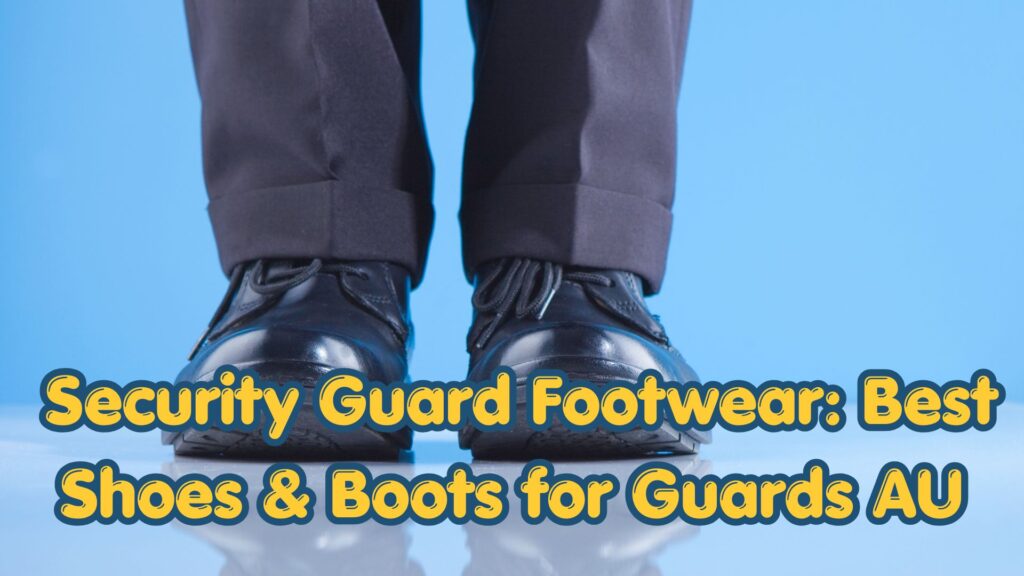
The best security guard footwear combines slip-resistant soles, cushioned midsoles, ankle support, and a professional appearance suitable for uniform wear. For outdoor and industrial roles, composite toe tactical boots (Steel Blue, Blundstone, Garmont T8) meeting AS/NZS 2210.3:2019 are the gold standard. For indoor and concierge roles, professional leather shoes with cushioned insoles are more appropriate. The single most important factor for long shifts: arch support and shock-absorbing cushioning — without it, plantar fasciitis, knee pain, and back problems follow.
- Why the right footwear is a health and safety issue for security guards
- The 7 features every pair of security guard shoes must have
- Four types of security guard footwear — and which role each suits
- Best shoe and boot brands for Australian security guards (2026)
- Australian safety footwear standard AS/NZS 2210.3:2019 explained simply
- Role-by-role footwear guide — patrol, construction, event, concierge
- The health risks of the wrong footwear — and how to prevent them
- Complete buying checklist before you purchase your next pair
A security guard’s feet are their most important tool. Whether conducting overnight mobile patrol across an industrial precinct, standing a 12-hour static post at a Melbourne construction site, managing crowds at an event, or working a concierge security position in a corporate lobby — the quality of their footwear directly determines their comfort, performance, safety, and long-term health.
And yet footwear is one of the most under-researched purchase decisions security professionals make. Guards routinely spend considerable money on uniforms and equipment while buying the cheapest available boots — then wonder why they are dealing with plantar fasciitis, swollen ankles, and back pain within months.
This guide from SSP Australia — a Melbourne-based security company with 15+ years of experience deploying guards across every type of environment in Victoria — gives security guards, security officers, and employers everything they need to choose the right footwear for every security role and work environment in Australia.
Why Footwear Is a Critical Issue for Security Guards
The average security guard on an active patrol shift walks 8 to 15 kilometres per shift and spends the majority of their working hours on their feet. Static guards may stand in one position for hours at a time. The cumulative physical stress this places on the feet, ankles, knees, hips, and lower back is enormous — and it is directly modifiable by footwear choice.
Poor-quality shoes can lead to swollen feet, joint pain, or even long-term health problems like plantar fasciitis. So whether you are in security officer boots guarding an event or patrolling a warehouse on a long shift, your security footwear needs to actively support your body — not simply cover your feet.
Beyond personal health, footwear matters for several professional and legal reasons in the Australian context:
- Workplace safety compliance — security guards working in designated high-risk environments (construction sites, industrial facilities, warehouses) are legally required to wear appropriate safety footwear under the Occupational Health and Safety Act 2004 (Vic) and employer duty-of-care obligations
- Performance on the job — a guard experiencing foot pain loses focus and alertness. Comfort is not a luxury in security work — it is a performance prerequisite
- Professional appearance — security footwear must meet uniform standards and project a professional image appropriate to the role and environment
- Emergency readiness — a guard who needs to run, change direction rapidly, or respond physically to an incident requires footwear that supports these demands
7 Features Every Security Guard Shoe Must Have
Regardless of the role or environment, these seven features are non-negotiable when choosing footwear for security work. A shoe missing any of these is not appropriate for professional security use.
1. Slip-Resistant Outsole
Security guards work across wet floors, oily surfaces, polished concrete, and uneven ground. A rubber outsole with deep, multi-directional tread pattern is essential. Look for boots rated SRA or SRB under AS/NZS 2210.3:2019 for laboratory-verified slip resistance.
2. Cushioned Shock-Absorbing Midsole
An EVA (Ethylene Vinyl Acetate) or polyurethane midsole absorbs impact with each step, dramatically reducing fatigue over 8–12 hour shifts. Steel Blue's Trisole Comfort Technology and Blundstone's air-cushioned insole are examples of high-performance midsole systems trusted by Australian security professionals.
3. Arch and Heel Support
An ergonomic contoured footbed — or the ability to insert orthotics — that supports the arch and cradles the heel is critical for guards on long shifts. Flat insoles with no arch support are the leading cause of plantar fasciitis in security personnel. Steel Blue's Ortho Rebound footbed is specifically engineered to shape to the foot's contour.
4. Ankle Support
Security guards regularly navigate uneven terrain, stairs, loading areas, and sloped surfaces. Mid-cut or high-cut boots with firm ankle support significantly reduce the risk of ankle sprains and rolls, particularly on overnight and outdoor patrols. Six-inch boots offer the balance of support and mobility most security guards need.
5. Breathable Moisture-Wicking Lining
Sweaty feet during long shifts lead to blisters, bacterial growth, and discomfort. A breathable upper (nylon mesh panels or perforated leather) combined with a moisture-wicking anti-microbial lining keeps feet dry and odour-free. Anti-microbial linings also prevent odour and extend the boot's lifespan.
6. Professional, Uniform-Appropriate Appearance
Security footwear must meet uniform standards. For most Victorian security roles, this means black polishable leather or high-quality synthetic uppers with a clean, formal silhouette. Worn, scuffed, or non-uniform footwear undermines the professional image essential to the role.
7. Appropriate Toe Protection for the Environment
Guards working in industrial, construction, or warehouse environments need toe cap protection — composite or steel — rated to 200 joules per AS/NZS 2210.3:2019. For office and concierge roles, standard dress footwear without toe caps may be appropriate but should still be reinforced for durability.
4 Types of Security Guard Footwear Explained
Not all security environments require the same footwear. Understanding the four main categories of security guard footwear helps you match the right shoe to the right role — and avoid the common mistake of buying patrol boots for a concierge role, or dress shoes for a construction site.
Tactical / Patrol Boots
Tactical boots are the most widely used footwear category in the security industry. Designed to balance durability, ankle support, and professional appearance, they are the standard choice for guards in patrol, mobile security, construction, and general outdoor roles. They are often the same shoes police wear and are trusted in demanding fields because they are made to withstand pressure.
Tactical boots are typically available in 6-inch and 8-inch shaft heights. Six-inch boots give plenty of ankle support while being lightweight and comfortable — the most popular choice for active patrol work. Eight-inch boots provide maximum ankle protection and are suited to rough terrain and construction environments. Side-zip entry models allow rapid on-and-off during long shifts.
- Polishable leather or Cordura nylon upper
- Side-zip or quick-lace closure
- Slip-resistant rubber outsole
- EVA or foam cushioned midsole
- Optional composite or steel toe
- Moisture-wicking anti-microbial lining
- Mobile patrol officers
- Construction site guards
- Event security guards
- Night security guards
- Warehouse security
- General outdoor security
Safety Boots — AS/NZS 2210.3:2019 Rated
Certified safety boots meet the Australian and New Zealand safety footwear standard AS/NZS 2210.3:2019, which requires toe cap protection rated to 200 joules of impact and 15 kilonewtons of compression — approximately a 20kg weight falling from one metre. These boots are legally required for security guards working on construction sites, industrial facilities, warehouses, and any other environment where falling objects, sharp materials, or machinery present a risk.
Safety boots are available with composite toe caps (lighter, non-metallic — best for most security roles) or steel toe caps (heavier, maximum protection — for very high-impact industrial environments). Composite toe boots are generally preferred by security guards because they are lighter, do not conduct temperature, and do not trigger metal detectors.
- AS/NZS 2210.3:2019 rating label
- SRA/SRB slip resistance marking
- Composite (C) or steel (S) toe designation
- Penetration resistance (P) marking for sharp objects
- Electrical hazard (EH) rating where required
- Construction site security
- Warehouse and logistics security
- Industrial and mining sites
- Loading dock environments
- Any site with falling object risk
Professional Dress Shoes / Low-Cut Safety Shoes
For security guards in corporate, concierge, retail, and front-of-house environments, traditional tactical boots may be incompatible with the professional dress standards required. In these settings, black polished leather Oxford-style shoes or smart low-cut safety shoes offer the formal appearance required while still providing essential comfort features for long-shift standing.
Modern professional security shoes combine a formal exterior with features previously reserved for work boots — cushioned insoles, slip-resistant outsoles, and reinforced construction. They are designed to look like business dress shoes while performing like occupational footwear. Guards working in Melbourne’s corporate CBD offices, luxury apartment buildings, and hotel concierge positions typically require footwear in this category.
- Polished leather or premium synthetic upper
- Oxford or Derby lace-up style
- Cushioned insole for static standing
- Slip-resistant outsole (often hidden tread)
- Formal black finish — uniform appropriate
- Concierge security guards
- Corporate lobby security
- Retail and shopping centre guards
- Reception and front desk security
- Hotel and hospitality security
Athletic / Lightweight Tactical Runners
Lightweight tactical runners bridge the gap between traditional boots and athletic shoes — offering the agility and comfort of a running shoe with the grip, durability, and professional appearance appropriate for security work. They are particularly suited to event security guards who need to move quickly across large venues, crowd managers at festivals, and guards in roles requiring rapid repositioning throughout a shift.
Brands like Under Armour (Valsetz series) and Salomon produce tactical runners that have gained significant traction among Australian security and law enforcement professionals. These shoes prioritise speed and agility over maximum ankle support and are best suited to lower-risk, high-mobility environments rather than construction or industrial sites.
Key Features
- Ultra-lightweight upper (300–500g per shoe)
- Athletic cushioning platform
- Aggressive rubber outsole for grip
- Low-profile professional appearance
- Breathable mesh panels
Best For These Roles
- Event and festival security
- Crowd management roles
- High-mobility patrol positions
- Warm-weather outdoor guard roles
- Close protection officers
Best Shoe and Boot Brands for Australian Security Guards (2026)
The Australian safety footwear market has a strong selection of locally respected brands alongside internationally proven tactical boot makers. Here are the brands most trusted by Australian security professionals in 2026, based on performance, durability, compliance, and value.
| Brand / Model | Type | AS/NZS 2210.3 | Composite Toe | Side Zip | Best For |
|---|---|---|---|---|---|
| Steel BlueSouthern Cross / Torquay range | Safety boot | ✓ | ✓ | ✓ | All-environment Australian security — emergency services, warehouses, construction |
| Blundstone550 series / Safety range | Safety boot / tactical | ✓ | ✓ | ◆ | Durability and comfort — popular with Melbourne-based security personnel |
| Garmont T8 LE 2.0Law Enforcement edition | Tactical boot | ◆ | ✓ | ✓ | Premium tactical security — ADF, police, and professional security operators |
| Hard YakkaAtomic / 3056 range | Safety boot | ✓ | ✓ | ✓ | Value — Australian-made brand with strong safety certification coverage |
| Under Armour ValsetzTactical series | Tactical runner / boot | ✗ | ◆ | ✓ | High-mobility roles — event security, crowd management, warm weather |
| Propper Series 100Duty boot range | Tactical boot | ✗ | ✓ | ✓ | Purpose-built security industry boot — patrol, event, and static duty roles |
| KingGee Comp-TecTerra Firma Hybrid | Safety boot | ✓ | ✓ | ✓ | Construction and industrial security — Australian-specific safety rating |
✓ Full ◆ Partial / model-specific ✗ Not available or not applicable. Always verify current specifications with the manufacturer.
🇦🇺 Australian Brand Highlight: Steel Blue
Steel Blue is a leader in safety footwear for Australian Police Officers, Paramedics, Corrections Officers, Security Guards and other Emergency frontline workers. Their Trisole Comfort Technology absorbs shock and impact while their Ortho Rebound footbed shapes to the foot for exceptional comfort — making Steel Blue one of the most widely trusted brands across Melbourne’s security and emergency services community. From construction workers in Melbourne’s CBD to security guards across Victoria, their Southern Cross boot remains a benchmark.
Role-by-Role Footwear Guide — What to Wear for Each Security Position
The security guard duties you perform and the environment you work in should be the primary determinant of your footwear choice. Here is a direct, role-specific guide.
| Security Role | Recommended Footwear Type | AS/NZS 2210.3 Required? | Key Priority |
|---|---|---|---|
| Mobile Patrol Officer | 6-inch tactical boot — composite toe, side-zip | Recommended | Ankle support, slip resistance, quick entry/exit from vehicle |
| Construction Site Guard | 8-inch safety boot — AS/NZS 2210.3 certified, composite or steel toe | Yes — legally required | Toe protection, penetration resistance, slip resistance on rubble |
| Warehouse Security Guard | 6–8 inch safety boot — composite toe, slip-resistant | Yes — legally required | Toe cap protection, cushioning for concrete floors, slip resistance |
| Event Security Guard | Tactical runner or 6-inch tactical boot | Situational | Agility, comfort during standing/crowd movement, professional appearance |
| Concierge Security Guard | Professional leather shoes or smart low-cut safety shoes | No | Formal appearance, cushioning for prolonged static standing |
| Corporate Security Guard | Professional dress shoes or low-profile tactical shoes — black leather | No | Dress code compliance, all-day standing comfort, polished appearance |
| Night Security Guard | 6-inch tactical boot — waterproof where outdoor | Environment-dependent | Waterproofing, warmth, grip on wet surfaces, ankle support |
| Close Protection Officer | Lightweight tactical runner or smart low-profile tactical boot | No | Discretion, rapid movement capability, professional appearance |
Australian Safety Footwear Standards Explained Simply
For security guards and employers, understanding Australian safety footwear standards is essential — particularly for roles on construction sites, industrial facilities, and warehouses where appropriate PPE is a legal requirement.
⚖ AS/NZS 2210.3:2019 — What It Means for Security Guards
AS/NZS 2210.3:2019 is the primary Australian and New Zealand safety footwear standard. It requires safety footwear to incorporate a toe cap that provides protection against an impact of 200 joules and a compression of 15 kilonewtons — approximately a 20kg weight falling from 1 metre onto the toe, or a compression weight of 1.5 tonnes. The toe cap does not have to be made of steel to meet this standard — composite materials provide equivalent protection at lower weight.
When buying safety footwear for security work, look for boots labelled with AS/NZS 2210.3:2019 compliance. Additional markings on certified boots include: SRA (slip resistance on ceramic tile with sodium lauryl sulphate), SRB (slip resistance on steel with glycerol), E (energy absorption of seat region), and P (penetration resistance — important for construction sites).
Under WorkSafe Victoria guidelines, employers must provide appropriate PPE — including compliant safety footwear — for workers in environments where foot injury risk has been identified. Security companies operating guards on construction sites and industrial facilities must ensure all deployed guards are wearing compliant footwear or risk enforcement action.
Health Risks of Wrong Security Guard Footwear — and How to Prevent Them
The health consequences of poor footwear choice are well-documented for workers in standing and walking professions. Security guards — particularly those in outdoor patrol and static guard roles — are among the most at-risk occupational groups. Understanding these risks helps guards and employers make informed footwear decisions.
Plantar Fasciitis
Inflammation of the plantar fascia ligament connecting heel to toes. Caused by lack of arch support and cushioning during prolonged standing. The most common foot injury in security guards — often begins as heel pain after shifts. Prevention: contoured footbed with arch support, EVA midsole cushioning.
Ankle Sprains
Sudden rolling of the ankle on uneven terrain — particularly common in outdoor patrol environments. Prevention: mid-cut or high-cut tactical boots with firm lateral ankle support. Particularly important for guards covering rough ground at night.
Metatarsalgia
Pain and inflammation in the ball of the foot, caused by inadequate forefoot cushioning during prolonged walking. Prevention: roomy toe box that does not compress the forefoot, cushioned metatarsal padding in the insole.
Knee and Hip Pain
Improper foot support leads to misalignment up the kinetic chain — causing progressive knee and hip joint stress over months and years of shift work. Prevention: correct arch support and heel cushioning that maintains proper gait alignment throughout the shift.
Lower Back Pain
Poor foot support and shock absorption during prolonged standing and walking transfers impact stress to the lumbar spine. Prevention: shock-absorbing midsole that reduces impact at the foot before it travels up the body.
Blisters and Fungal Infections
Friction from ill-fitting boots and moisture from perspiration create environments where blisters and fungal growth thrive. Prevention: correct size fitting (half size up for thick socks), moisture-wicking lining, and anti-microbial treatments.
Complete Buying Checklist — Before You Buy Security Guard Footwear
Use this checklist before purchasing any footwear for security guard use. Ticking every point significantly reduces the chance of an expensive mistake — or a painful one.
- Identify your primary environment — outdoor patrol, construction site, indoor concierge, or event crowd management? Each environment has different footwear priorities. Do not buy construction site boots for a corporate lobby role, or dress shoes for a night patrol shift.
- Check if AS/NZS 2210.3:2019 compliance is required — if you work in any environment where falling objects, machinery, or sharp materials are present, certified safety footwear is a legal requirement. Look for the AS/NZS rating label inside the boot.
- composite over steel toe for most security roles — lighter, non-conductive, does not trigger metal detectors, and provides equivalent protection under AS/NZS 2210.3:2019.
- Prioritise cushioning and arch support over appearance — the most important performance criteria for long shifts is what happens inside the shoe, not outside it. Evaluate the midsole and footbed quality before anything else.
- Try them on with the socks you will wear on shift — tactical socks are often thicker than standard socks. If you use thick socks, consider sizing up half a size. A proper fit prevents blisters and ensures all-day comfort during long shifts.
- Check waterproofing requirements — outdoor patrol guards in Melbourne, particularly during winter, require waterproof uppers (full-grain leather or waterproof membrane). Indoor guards typically do not need waterproofing but benefit from breathable uppers.
- Allow for a break-in period — even the best quality boots require 1–2 weeks of break-in to soften and form to your foot. Start wearing new boots on lighter shifts before using them for a full 12-hour patrol. New boots worn straight into a heavy shift are a common cause of blisters.
- Budget appropriately — quality security guard footwear in Australia ranges from approximately $150 to $350 AUD for certified safety boots. Spending at the higher end of this range typically yields 18–24 months of use versus 6–9 months for budget options — making premium boots more cost-effective over time.
- Check your employer’s uniform requirements — many security companies specify the colour, style, and height of approved footwear. Confirm these requirements before purchasing to avoid buying non-compliant footwear that cannot be worn on duty.
How to Care for Security Guard Footwear
The lifespan of quality security guard boots depends as much on care as it does on construction quality. Proper maintenance keeps boots performing at their best and extends their working life significantly.
- Clean after every shift — remove dirt and debris from the upper and outsole after each shift. Dried mud and grit accelerate sole wear and crack leather uppers.
- Polish leather uppers regularly — for polishable leather boots, a weekly polish maintains the professional finish required for uniform standards and conditions the leather to prevent cracking.
- Use cedar shoe trees between shifts — cedar inserts absorb moisture and maintain the boot’s shape during storage, dramatically extending the life of the upper structure.
- Allow boots to dry naturally — never dry wet boots near direct heat (radiators, in direct sunlight). Heat destroys the adhesives bonding the sole to the upper and dries out leather. Stuff with newspaper and air-dry at room temperature.
- Replace insoles regularly — the footbed compresses faster than the outer boot. Replacing insoles every 6 months with quality aftermarket orthotics (or OEM replacements) maintains cushioning performance even as the outer boot continues to serve well.
- Inspect soles monthly — check the tread depth and sole-to-upper bond monthly. Worn tread on a slip-resistant outsole dramatically reduces its effectiveness. If the tread pattern is smooth, replace the boots regardless of how the upper looks.
Looking for a Melbourne security company that equips its guards properly?
Need Licensed, Professional Security Guards in Melbourne?
SSP Australia provides fully trained, Victoria Police licensed security guards across Melbourne and Greater Victoria — properly equipped for every environment, 24/7. Free quotes in 60 minutes.
Frequently Asked Questions
1. What is the best footwear for security guards in Australia?
2. What should I look for in comfortable security guard shoes for long shifts?
3. Do security guards in Australia need to wear certified safety footwear?
4. Are composite toe boots better than steel toe for security guards?
5. How long do security guard boots typically last?
6. What is the difference between security guard boots and regular work boots?
Hasham Khalid
Founder & Director — SSP Australia
Hisham Khalid founded SSP Australia in Melbourne in 2009. With 15+ years of experience in the Victorian security industry, he leads a team of 50+ licensed security guards serving construction, industrial, healthcare, retail, and event clients across Greater Victoria.