- The difference between public liability and general liability insurance for security guards
- Which types of insurance are legally required for security businesses in Victoria
- What self-employed and independent contractor security guards need to cover themselves
- How much security guard insurance costs in Australia in 2026
- What to look for when choosing a policy — and what to avoid
Table of Contents
Security guards operate in one of Australia’s most legally exposed professions. Every shift carries the potential for physical confrontation, property damage, wrongful detention claims, or personal injury — situations that can quickly translate into costly legal action against the guard, their employer, or both. Without the right insurance in place, a single incident can result in financial devastation for an individual guard or an entire security business.
Yet insurance remains one of the most misunderstood topics in the Australian security industry. Many guards — particularly those transitioning to self-employment or contract work — are unclear about what coverage they need, what their employer’s policy actually covers, and what their obligations are under Victorian law. This guide answers all of those questions clearly, in plain language, so that every security guard and security business in Australia can make informed decisions about their protection.
Why Insurance Matters in the Security Industry
The security industry is inherently high-risk. Guards regularly work in environments where physical confrontations, accidents, property damage, and emergency situations are not theoretical possibilities — they are occupational realities. The legal and financial consequences of an uninsured incident in this industry can be severe.
Consider a few real-world scenarios that illustrate why insurance for security guards is non-negotiable:
- A security guard conducting a patrol at a warehouse accidentally damages expensive equipment worth $40,000. Without public liability insurance, the guard or their employer pays out of pocket.
- A guard detains a person suspected of shoplifting who later claims wrongful detention and sues for damages. Without professional indemnity coverage, the legal costs alone could be ruinous.
- A visitor to a site slips and falls in an area under a guard’s supervision and suffers a serious injury. The resulting personal injury claim runs to six figures.
- A self-employed security contractor working an event is accused of using excessive force. Without their own insurance, they are personally liable for all legal defence costs and any settlement.
Beyond the financial risk, insurance is a legal requirement for licensed security businesses in Victoria — and a commercial expectation from virtually every client. Businesses hiring insured security guard company in Melbourne routinely require proof of insurance before signing any contract.
Yet insurance remains one of the most misunderstood topics in the Australian security industry. Many guards — particularly those transitioning to self-employment or contract work — are unclear about what coverage they need, what their employer’s policy actually covers, and what their obligations are under Victorian law. This guide answers all of those questions clearly, in plain language, so that every security guard and security business in Australia can make informed decisions about their protection.
Types of Insurance for Security Guards Explained
There is no single “security guard insurance” product in Australia. Rather, comprehensive protection is built from several distinct policy types, each covering different risks. Here is a breakdown of every type of insurance that security guards and security businesses should understand.
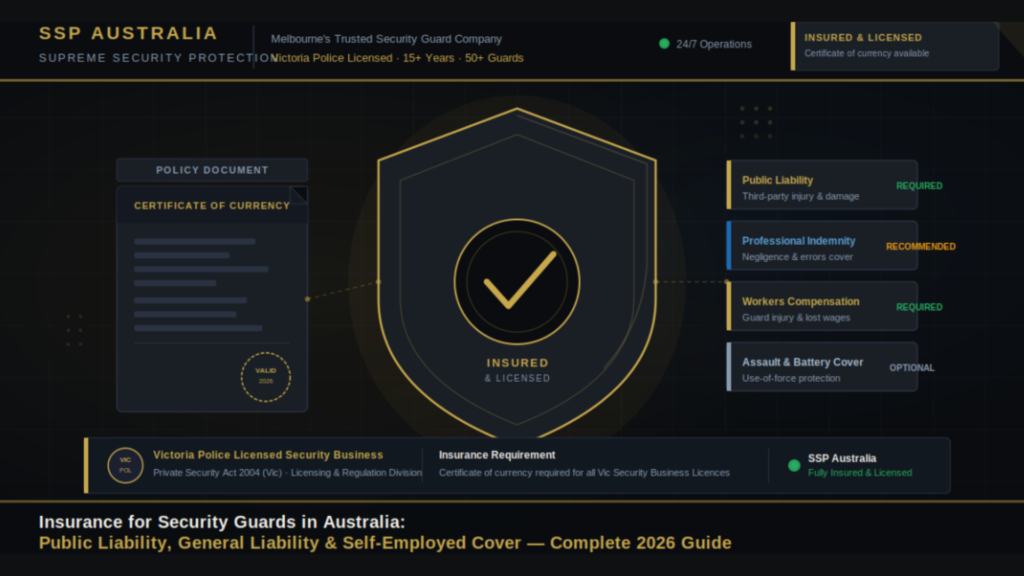
Public Liability Insurance
Also known as General Liability Insurance
Public liability insurance is the foundational insurance policy for every security guard and security business in Australia. It covers claims made by third parties — members of the public, clients, or property owners — for bodily injury or property damage caused by the guard or their employer’s operations.
If a guard accidentally injures someone, causes damage to a client’s property, or a third party suffers harm as a result of a security operation, public liability insurance covers the legal costs, compensation payments, and related expenses up to the policy limit.
In Victoria, public liability insurance is a mandatory requirement for Security Business Licence applicants under the Private Security Act 2004 (Vic). Victoria Police requires a current certificate of currency showing adequate coverage as part of every business licence application.
Coverage levels for security operations in Australia typically range from $5 million to $20 million. Most commercial clients and government contracts require a minimum of $10 million in public liability coverage.
Professional Indemnity Insurance
Also known as Errors & Omissions (E&O) Insurance
Professional indemnity insurance covers claims arising from alleged negligence, professional errors, or failure to perform contracted security duties. This is distinct from public liability — it protects against claims of professional failure rather than physical injury or property damage.
For security guards, professional indemnity covers situations such as: a guard who fails to detect a break-in that results in significant loss; a crowd controller accused of failing to prevent an assault at an event; or a security company accused of providing inadequate protection under a commercial contract.
Professional indemnity is particularly important for security companies with formal service contracts, as clients may pursue damages if they believe security obligations were not fulfilled. Corporate and government clients increasingly require proof of professional indemnity coverage alongside public liability.
Workers Compensation Insurance
Mandatory for all employers with security staff
Workers compensation insurance is legally required for every employer in Victoria with one or more employees. It covers medical expenses, rehabilitation costs, and lost wages for security guards who are injured or become ill in the course of their employment.
Given that security work involves significant physical risk — including confrontations, patrol-related injuries, and extended physical exertion — workers compensation is an essential protection for both guards and their employers. Claims can arise from physical altercations, slips and falls during patrols, repetitive strain injuries, and psychological trauma following critical incidents.
In Victoria, workers compensation is managed through the WorkSafe Victoria scheme. Employers must register and pay premiums based on their industry risk classification and total wages bill. Failure to hold workers compensation when legally required is a serious offence.
Assault & Battery / Use-of-Force Liability
Specialist endorsement for physical intervention situations
Many standard public liability policies contain exclusions for assault, battery, and use-of-force incidents. This is a critical gap that many security businesses discover only when they try to make a claim. Crowd controllers, event security guards, and armed security guards are especially exposed to this risk.
A specific assault and battery endorsement — or a policy that explicitly includes use-of-force coverage — ensures that claims arising from physical restraint, ejection of patrons, or other force-related incidents are covered. Without this endorsement, a guard who physically intervenes during an incident may find their employer’s standard policy does not respond to the resulting claim.
Always confirm with your insurer whether your policy covers use-of-force situations before accepting any role requiring physical intervention.
Commercial Vehicle / Mobile Patrol Insurance
For patrol vehicles and company transport
Security companies operating mobile patrol vehicles across Melbourne must ensure their vehicles are covered under a commercial motor vehicle policy — not a standard personal vehicle policy. Personal policies typically exclude vehicles used for commercial purposes, leaving patrol operators exposed in the event of an accident.
Commercial vehicle insurance for security patrol cars covers damage to the vehicle, third-party property damage, and personal injury arising from patrol operations. It should explicitly reference the commercial security purpose of the vehicle to avoid any coverage disputes.
Public Liability vs General Liability Insurance — What Is the Difference?
This is one of the most common points of confusion for Australian security guards researching their insurance options — particularly when reading international resources or speaking with overseas-based insurers.
💡 Key Clarification:
In Australia, “public liability insurance” is the standard industry term for what is called “general liability insurance” in the United States. They cover the same fundamental risks: third-party bodily injury and property damage claims. When you see “general liability insurance for security guards” in Australian search results, it is referring to the same product as public liability insurance. Both terms describe coverage for claims made against you by third parties arising from your operations.
The terminology divergence exists purely because of different industry conventions between Australia/UK and the US. Australian insurers, brokers, Victoria Police, and the Private Security Act 2004 (Vic) all use the term “public liability” — so this is the term you should use when speaking to Australian insurers, clients, and regulators.
| Aspect | Australian Term | US / International Term |
|---|---|---|
| Official name in Australia | Public Liability Insurance | Commercial General Liability (CGL) |
| Covers third-party injury | ✓ Yes | ✓ Yes |
| Covers third-party property damage | ✓ Yes | ✓ Yes |
| Required under Victorian law | ✓ Yes — for security businesses | N/A — not an Australian product |
| Used in Victorian licence applications | ✓ Yes | ✗ Not applicable |
| Available from Australian insurers | ✓ Yes | ✗ Different product structure |
Insurance for Self-Employed Security Guards in Australia
The growth of contract and self-employed security work across Australia has created a significant insurance knowledge gap. Many guards transitioning from employed positions to self-employment or ABN contracting assume they remain covered under their former employer’s policy. They do not.
Once you operate as a sole trader, independent contractor, or self-employed security guard with your own ABN, you are personally responsible for your own insurance. You are not covered by a client company’s employer liability policy when operating as an independent contractor — you are a separate business entity.
If you are working as a self-employed or contract security guard in Victoria without your own public liability insurance, you are personally liable for any third-party injury, property damage, or professional negligence claim arising from your work. A single serious incident could result in a lawsuit that exceeds your personal assets. Do not operate without coverage.
What Self-Employed Security Guards Need
As a self-employed security guard operating in Victoria, you should consider the following minimum insurance coverage:
This is your foundational coverage. Covers third-party injury and property damage claims arising from your security work. Many clients require a certificate of currency showing $10 million in coverage before engaging a self-employed guard.
Covers claims of professional negligence or failure to perform your contracted security duties. Particularly important if you work under formal service agreements with clients rather than on casual labour-hire terms.
As a self-employed person, you have no workers compensation entitlements if you are injured on the job. Personal accident and illness insurance provides income protection and medical expense coverage if you are injured or become ill and cannot work.
If your self-employed security work involves crowd control, physical intervention, or close-protection services, confirm that your public liability policy includes or can be endorsed to cover use-of-force situations. Many standard policies exclude this.
Self-employed security guards in Australia can obtain insurance through specialist security industry brokers, online platforms such as BizCover, or directly from insurers who write security industry policies. Always use an insurer or broker who has experience with the security industry — generic business insurance policies may contain exclusions that make them unsuitable for security work.
Once you operate as a sole trader, independent contractor, or self-employed security guard with your own ABN, you are personally responsible for your own insurance. You are not covered by a client company’s employer liability policy when operating as an independent contractor — you are a separate business entity.
Victorian Legal Requirements — What the Law Says
The primary legislation governing security insurance requirements in Victoria is the Private Security Act 2004 (Vic). This Act, administered by the Victoria Police Licensing and Regulation Division, sets out the licensing conditions for both individual security guards and security businesses operating in Victoria.
For Security Business Licence applicants: Victoria Police requires a certificate of currency from an insurance provider confirming current public liability insurance coverage for the specific security activities being applied for. The certificate must show the coverage amount, policy period, and the activities covered. A licence will not be granted without this evidence.
For Individual Operator Licence holders: Individual guards employed by a licensed security business are covered under their employer’s policy. However, self-employed guards and independent contractors must hold their own coverage — their individual licence does not automatically provide insurance protection.
From June 2025: All private security activities in Victoria became licensed occupations under updated regulations. Anyone working independently or operating a security business must hold both an Individual Operator Licence and a Private Security Business Licence — increasing compliance and insurance obligations across the industry.
How Much Does Security Guard Insurance Cost in Australia?
Insurance costs for security guards and security companies vary significantly based on the size of the operation, the type of services provided, the coverage level required, and the insurer’s assessment of risk. The following figures are indicative ranges based on current Australian market pricing as at 2026.
These are indicative figures only. Actual premiums depend on your specific operations, claims history, coverage limits, and the insurer’s risk assessment. Always obtain multiple quotes from brokers experienced in the security industry.
How to Choose the Right Security Guard Insurance Policy
Not all insurance policies marketed to security businesses are equal — and choosing the wrong one can leave you with critical gaps in coverage. Here is what to assess before committing to any policy.
- Check for use-of-force exclusions. Read the policy exclusions carefully. Many standard public liability policies exclude assault, battery, and physical intervention. If your work involves crowd control, close protection, or any physical security role, you need a policy that explicitly covers these activities — or an endorsement that adds them.
- Confirm the policy covers your specific activities. The certificate of currency submitted to Victoria Police must specifically reference the security activities for which you are licensed. A generic business liability policy that does not mention security services may not be accepted.
- Check armed guard coverage separately. If any of your guards carry or are licensed to carry firearms, confirm that your policy covers armed security operations. Many standard policies exclude firearm-related incidents entirely and require a separate endorsement.
- Assess the coverage limit against your client contracts. Many commercial and government clients require $10 million to $20 million in public liability coverage as a contract condition. Ensure your limit meets or exceeds this requirement before tendering for contracts.
- Use a specialist security industry broker. General business insurance brokers may not understand the specific exclusions and coverage requirements of the security industry. A broker experienced in security industry placements will identify gaps that a generalist might miss.
- Review annually. Your insurance needs change as your business grows, your guard numbers increase, and your service mix evolves. Review your coverage at every renewal to ensure it still matches your operations.
How SSP Australia Approaches Insurance and Compliance
At SSP Australia, insurance and legal compliance are not afterthoughts — they are foundational to how we operate. As a Victoria Police licensed security company with 15+ years of experience in Melbourne, we understand that our clients place enormous trust in us when they engage our guards to protect their people and property.
Every aspect of SSP Australia’s insurance and compliance program reflects that responsibility:
- SSP Australia holds an active Security Business Licence issued by Victoria Police under the Private Security Act 2004 (Vic)
- We carry comprehensive public liability insurance — our certificate of currency is available to clients on request
- Every SSP security guard is covered under our company’s insurance program — no guard is deployed without adequate coverage in place
- All guards hold individual Victoria Police Private Security Licences — 100% of our workforce, no exceptions
- Our insurance coverage is reviewed and updated annually to ensure it reflects the full scope of our service operations across Melbourne and Victoria
When you hire SSP Australia, you are not just hiring trained guards — you are engaging a fully compliant, fully insured security company that takes its legal and professional obligations seriously. For clients, this means peace of mind that your site, event, or facility is protected by a provider who can demonstrate every credential when asked.
Looking for a Fully Insured Security Guard Company in Melbourne?
SSP Australia is Victoria Police licensed, fully insured, and ready to deploy 50+ trained security guards across Melbourne and Greater Victoria — 24/7.
Or call us directly: 0497 777 786
Frequently Asked Questions
Is public liability insurance mandatory for security guards in Victoria?
What is the difference between public liability and general liability insurance for security guards?
Do self-employed security guards need their own insurance in Australia?
How much does public liability insurance cost for a security guard in Australia?
What does professional indemnity insurance cover for security guards?
Does SSP Australia carry public liability insurance?
Hasham Khalid
Founder & Director — SSP Australia
Hisham Khalid founded SSP Australia in Melbourne in 2009. With 15+ years of experience in the Victorian security industry, he leads a team of 50+ licensed security guards serving construction, industrial, healthcare, retail, and event clients across Greater Victoria.