- The exact difference between a security guard and a security officer in Australia
- How their roles, responsibilities, and authority levels differ in practice
- Victorian licensing and qualification requirements for both roles
- How much each role earns in Australia in 2026
- Which security professional your business needs — and when to use both
Table of Contents
Ask ten people in the security industry to explain the difference between a security guard and a security officer, and you will likely get ten slightly different answers. The terms are often used interchangeably in everyday conversation, job advertisements, and even by some employers — yet in Australia’s professional security industry, there is a meaningful distinction between the two roles that affects responsibility, authority, qualifications, pay, and career progression.
Whether you are a business owner trying to determine which type of security professional you need, a person considering a career in the security industry, or simply someone curious about how the industry is structured — this guide provides a clear, accurate, Australia-specific answer. We draw on Victorian licensing requirements, the Jobs and Skills Australia occupation classification (ANZSCO 4422), and 15+ years of operational experience in providing security guard services in Melbourne to break this down definitively.
Are a Security Guard and a Security Officer the Same Thing?
The short answer is no — though the distinction is frequently blurred in practice. Industry research from Indeed Australia confirms that employers often use the two titles differently, and some organisations advertise frontline posts as “security officer” roles even when duties are primarily fixed-post coverage. This inconsistency can make the distinction confusing for both job seekers and employers.
The clearest way to understand the difference is to look past job titles and focus on scope of responsibility, decision-making authority, and position in the security hierarchy. When you do, a consistent and meaningful distinction emerges across the Australian security industry.
💡 The Core Distinction in Plain Language
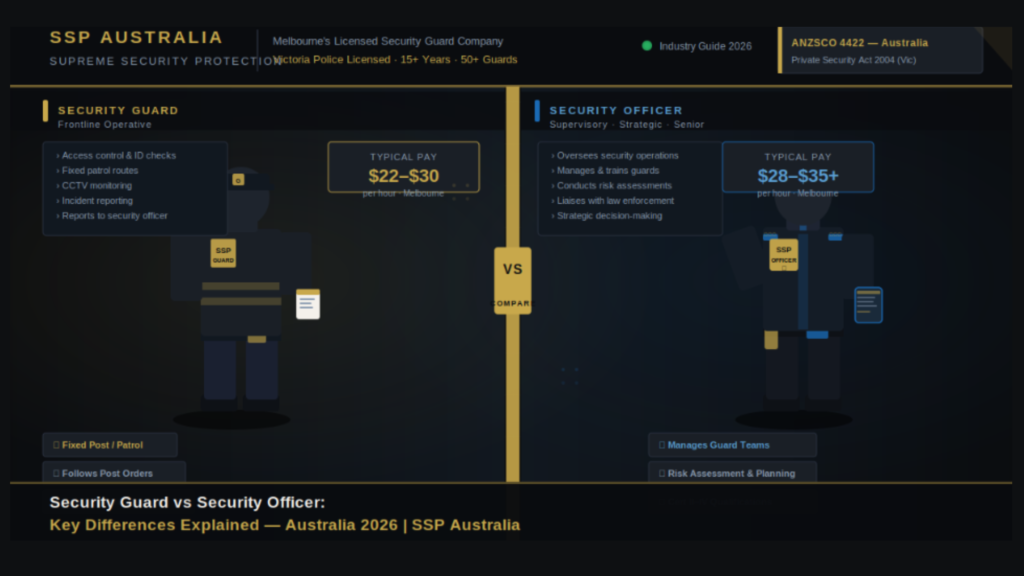
A security guard carries out security tasks. A security officer oversees and manages security operations — including directing the guards carrying out those tasks. Guards operate at the frontline; officers operate at the management level.
What Is a Security Guard?
The Frontline Operative
A security guard is a frontline security operative responsible for carrying out specific, defined security tasks under the direction of a security officer or site supervisor. The security guard role is typically the entry point into the professional security industry in Australia, and it forms the operational backbone of any security deployment.
Security guards operate primarily at a designated post or on a fixed patrol route, following post orders — the documented set of instructions specific to their site. Their work is procedural and consistent, designed to ensure predictability and coverage across a site.
Core responsibilities of a security guard include:
- Manning entry points and conducting access control — checking identification, issuing visitor passes, and managing queues
- Conducting timed patrols along set routes, checking doors, windows, and gates for unauthorized entry or security vulnerabilities
- Monitoring CCTV systems and reporting unusual activity to the security officer or control room
- Responding to alarms, disturbances, and incidents at their designated post — and reporting findings to their supervisor
- Completing daily activity logs and maintaining accurate incident records
- Enforcing site rules and providing visible deterrence against criminal activity
- Assisting members of the public — giving directions, answering enquiries, and providing a professional, customer-facing presence
For a comprehensive breakdown of what security guards do in specific environments, see our detailed guide on the duties and responsibilities of a warehouse security guard in practice.
Security guards are employed across a wide range of environments — from construction sites and retail centres to schools, hospitals, and residential buildings. They are the most visible element of any security operation, and their physical presence is itself one of the most effective deterrents against opportunistic crime.
SSP Australia’s security guarding services cover every major guard type — including static guards, mobile patrol guards, concierge guards, and event security guards — each trained and licensed for their specific deployment environment.
What Is a Security Officer?
The Strategic Supervisor
A security officer holds a more senior, strategic position within the security hierarchy. Where a security guard executes the security plan, a security officer is responsible for creating, overseeing, and managing that plan across a site or multiple locations. The security officer role involves significant decision-making authority, leadership responsibility, and operational coordination that goes well beyond frontline guard duties.
Security officers are typically mobile across a site rather than stationed at a fixed post. They rotate through security stations, assess the performance of guards under their supervision, triage alarm responses when multiple incidents occur simultaneously, and serve as the primary point of contact between the security operation and management, clients, or emergency services.
Core responsibilities of a security officer include:
- Overseeing the full security operation at one or more sites — assigning duties, managing shifts, and ensuring coverage
- Supervising, training, and mentoring security guards under their command
- Conducting risk assessments and security audits to identify vulnerabilities and recommend improvements
- Analysing access logs and CCTV data to assess risk patterns and document decisions
- Triaging multiple alarm responses simultaneously and directing patrol guards accordingly
- Liaising directly with Victoria Police, fire brigades, paramedics, and emergency services during critical incidents
- Writing detailed incident reports, security briefs, and recommendations for management review
- Developing and implementing site-specific security protocols and post orders
- Managing access for contractors, visitors, and tenants in complex, multi-tenancy environments
Security officers are most commonly found in complex, high-risk, or large-scale environments — corporate campuses, hospitals, airports, government facilities, large-scale events, and multi-site industrial operations. In these environments, the breadth of risk and the need for coordinated operational management demands a level of authority and expertise beyond what a frontline guard role provides.
Key Differences: Side-by-Side Comparison
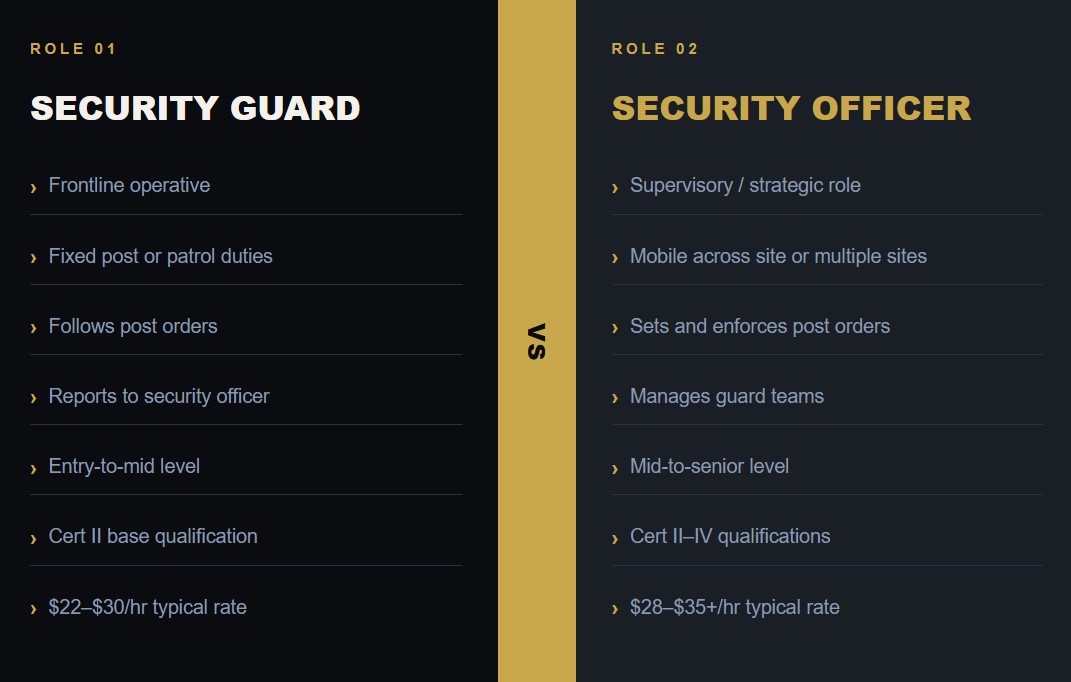
The table below provides a direct, structured comparison of the key differences between a security guard and a security officer across every major dimension.
| Factor | Security Guard | Security Officer |
|---|---|---|
| Rank / Level | Entry to mid-level — frontline operative | Mid to senior level — supervisory / managerial |
| Scope of Work | Specific, defined tasks at a fixed post or patrol route | Broad oversight of entire security operation — multiple posts and locations |
| Decision-Making | Follows post orders — limited independent judgment | Makes operational decisions — risk triage, incident escalation, resource allocation |
| Reporting Structure | Reports to security officer or supervisor | Reports to site manager or client — guards report to them |
| Mobility | Typically stationed at one post or fixed patrol route | Mobile across the entire site or multiple locations |
| Team Management | Not responsible for managing other staff | Manages, supervises, and trains security guard teams |
| Risk Assessment | Observes and reports risk — does not assess or plan | Conducts formal risk assessments and security audits |
| Emergency Liaison | Contacts supervisor or follows emergency procedure | Directly liaises with police, fire brigades, and paramedics |
| Base Qualification (Vic) | CPP20218 Certificate II in Security Operations | Cert II minimum; Cert III or IV for specialist/senior roles |
| Typical Pay (Melbourne) | $22–$30 per hour | $28–$35+ per hour |
| Typical Environments | Retail, construction, schools, events, residential | Hospitals, corporate campuses, government, airports, large events |
The Security Industry Hierarchy in Australia
Understanding the difference between a guard and an officer is easier when you see how both roles sit within the broader security industry structure. The hierarchy below reflects typical practice across the Australian security industry, including SSP Australia’s own operational structure in Melbourne.
Training and Qualifications Required in Australia
One of the clearest practical differences between a security guard and a security officer is the training pathway each role requires. The Australian Qualifications Framework (AQF) provides the national structure for security industry training, with specific qualifications mapped to different roles under the ANZSCO 4422 occupation classification.
Specialist Officer — Close Protection
Certificate III in Close Protection Operations
[CPP30619]Required for personal bodyguard services and close-protection work. Covers protective formation, threat assessment, advance work, emergency driving, and VIP protection protocols. One of the most specialised qualifications in the Australian security industry.
In Victoria, both security guards and security officers must hold a current Private Security Individual Operator Licence issued by the Victoria Police Licensing and Regulation Division (LRD), as required under the Private Security Act 2004 (Vic).
Updated regulations under the Private Security and County Court Amendment Act 2024 — which came into effect on 19 June 2025 — introduced additional licensing requirements across the Victorian security industry. Both guards and officers must meet these updated standards.
To be eligible for a Victorian security licence, applicants must be 18 or older, hold Australian work rights, pass a national police check, have fingerprints taken, and complete the relevant approved training qualification from a Victoria Police approved Registered Training Organisation. Working without a current licence carries fines exceeding $20,000 and can result in a permanent ban from the industry.
Pay Rates for Security Guards and Officers in Australia (2026)
Pay reflects the difference in responsibility and training between these two roles. The following data is drawn from Jobs and Skills Australia (2025) and current Security Services Industry Award 2020 rates.
| Role / Experience Level | Hourly Rate | Annual (Approx.) |
|---|---|---|
| Entry-level security guard (0–1 yr) | $22–$25/hr | $45,000–$52,000 |
| Experienced guard (3–5 yrs) | $25–$30/hr | $52,000–$62,000 |
| Security officer (mid-level) | $28–$33/hr | $58,000–$68,000 |
| Senior security officer | $33–$38/hr | $68,000–$79,000 |
| Site supervisor / manager | $38–$45+/hr | $79,000–$95,000+ |
| Median — all guards & officers (AUS) | ~$30/hr | ~$63,000 |
Melbourne-based security professionals generally earn at the higher end of these ranges due to cost of living and strong local demand. Penalty rates for night shifts, weekends, and public holidays under the Security Services Industry Award 2020 can add significantly to base hourly rates.
Which Does Your Business Need — A Security Guard or Security Officer?
Understanding the difference is one thing — applying it to your specific security needs is another. Here is a practical guide to help Melbourne businesses determine the right security staffing for their situation.
You likely need a Security Guard if:
- Your site is low-to-medium risk and requires visible deterrence, access control, or regular patrols
- You need someone to man a fixed entry point, monitor a car park, or conduct building lock-ups
- You need event security guards for crowd management at a function or public event
- You require overnight protection for a construction site or warehouse
- Your security needs are straightforward, consistent, and do not require strategic oversight or team coordination
You likely need a Security Officer if:
- Your site is large, complex, or high-risk — requiring coordinated security management across multiple zones
- You need someone who can conduct risk assessments, develop security protocols, and manage a guard team
- Your operation involves a corporate security environment requiring executive liaison and strategic planning
- You require a control room operator or monitoring officer overseeing CCTV and alarm systems across a facility
- You need someone authorised to make operational decisions and liaise with police or emergency services independently
Many businesses need both:
In practice, the most effective security deployments combine both roles. Security officers manage operations, triage incidents, and coordinate guard teams — while security guards provide the visible, frontline presence that delivers deterrence and executes on-the-ground tasks. SSP Australia designs security programs using this combined approach, ensuring every Melbourne client gets the right mix of expertise at the right level of the hierarchy.
Career Pathways: From Security Guard to Security Officer and Beyond
The security industry offers a clear and well-defined career progression pathway in Australia. Many of the country’s most experienced security officers, supervisors, and managers began their careers as entry-level security guards — and the skills, experience, and qualifications gained at each level are directly transferable upward.
A typical career progression in Melbourne’s security industry looks like this:
- Complete a CPP20218 Certificate II in Security Operations at an approved Victorian RTO (2–3 weeks). Apply for a Victoria Police Private Security Licence. Begin working as a licensed security guard with a reputable company such as SSP Australia.
- Build on-the-job experience over 1–3 years across different site types — retail, construction, events, corporate — developing situational awareness, communication skills, and operational capability.
- Pursue additional qualifications — Certificate III in Security Operations, close protection certification, or specialist endorsements (crowd control, armed guard) to expand your licensing sub-activities and employment options.
- Progress to security officer — taking on supervisory responsibilities, managing guard teams, and handling more complex operational environments.
- Advance to site supervisor or operations manager — overseeing multiple sites, managing client relationships, and contributing to security planning at a strategic level.
Jobs and Skills Australia (2026) identifies security officers and guards as a growing occupation nationally, with strong employment demand across Melbourne and Greater Victoria. The industry offers both stability and genuine career advancement for motivated professionals.
Need Licensed Security Guards or Officers in Melbourne?
SSP Australia deploys fully licensed, professionally trained security guards and officers across Melbourne and Greater Victoria — 24/7. Whether you need frontline guard coverage or senior security officer management, we have the right team for your site.
Or call us directly: 0497 777 786
Frequently Asked Questions
1. What is the difference between a security guard and a security officer in Australia?
2. Do security guards and security officers need the same license in Victoria?
3. Is a security officer higher than a security guard?
4. How much do security guards and security officers earn in Australia?
5. Can a security guard become a security officer in Australia?
6. Which does my business need — a security guard or a security officer?
Hasham Khalid
Founder & Director — SSP Australia
Hisham Khalid founded SSP Australia in Melbourne in 2009. With 15+ years of experience in the Victorian security industry, he leads a team of 50+ licensed security guards serving construction, industrial, healthcare, retail, and event clients across Greater Victoria.