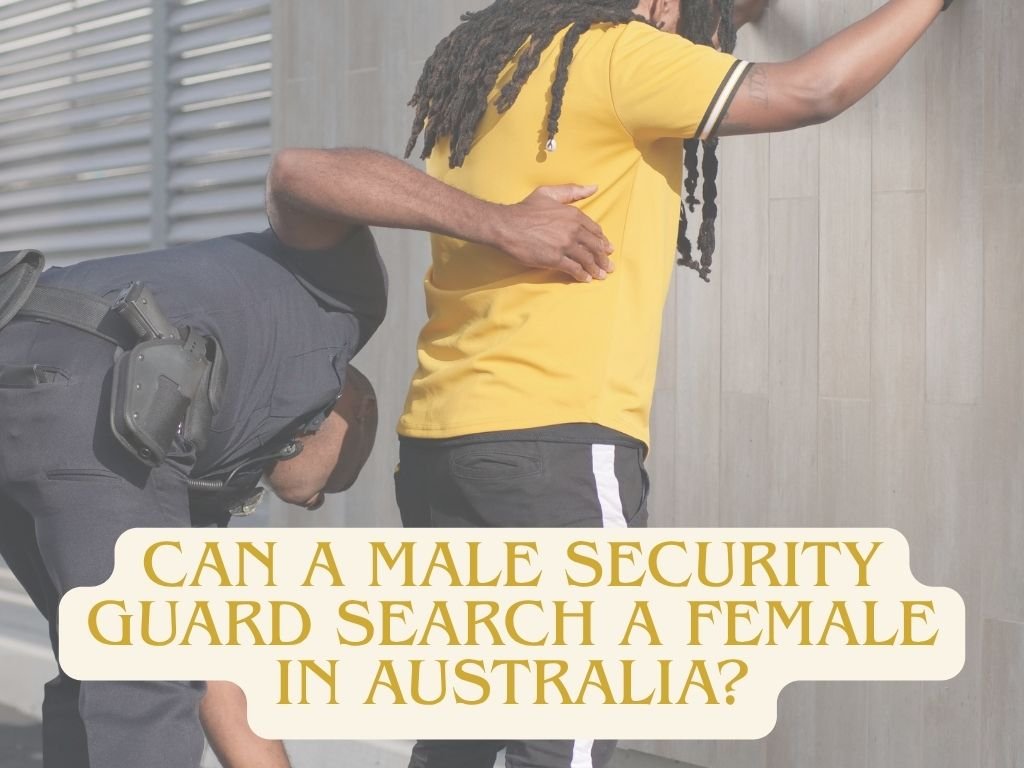
This question comes up constantly around festivals, nightclubs, and retail stores and most answers online get it half right. There is no single Australian law that states, in plain words, “a male guard cannot search a female.” But that doesn’t mean the answer is unclear. It builts from several legal principles working together. And once you understand how they combine, the practical answer is very clear.
This guide is written for both sides of the question. People wanting to know their rights, and business owners. And event organizers who need to get their search policy right. Getting this wrong isn’t just a compliance risk. It’s a legal one.
Quick Answer: No Australian statute explicitly bans a male security guard from searching a female. However, security guards can only search someone with genuine consent, cannot legally strip-search anyone, and are bound by anti-discrimination and workplace harassment laws. In practice, this means same-gender searches are the professional standard across Australia. And most licensed venues, festivals, and retailers build this directly into their search policy and staff training.
Security Guards Are Not Police — The Starting Point
Quick answer: Security guards in Australia hold licensed private authority, not police powers, they cannot search, detain, or use force the way a police officer can, regardless of gender.
Every answer to this question starts here. A security guard, crowd controller, or bouncer is a licensed private individual, not a sworn law enforcement officer. They don’t operate under the same legislation that gives police their search powers — legislation like the Law Enforcement (Powers and Responsibilities) Act 2002 (NSW) or its equivalents in other states.
That distinction matters because it changes what a “search” even legally means when a security guard does it. Our guide on what security guards can and cannot do covers this broader authority gap in detail.
Can a Security Guard Search You at All?
Quick answer: A security guard can only search you with your genuine consent. They cannot force a search on anyone, male or female, without it.
This is the single most important legal fact in this entire topic, and it’s easy to lose sight of once gender enters the conversation. A security guard’s power to search anyone — regardless of who they are — depends entirely on consent. No consent, no lawful search. Full stop.
In practice, “consent” usually shows up as a condition of entry. Music festivals, nightclubs, and large retail stores commonly state that entering the venue means agreeing to a bag or pat-down check. If you decline, the venue’s actual power isn’t to force the search — it’s to refuse you entry or ask you to leave. That’s the trade-off, not a search power in itself.
Did You Know? Because search powers are consent-based, a person can always decline a search from any guard — the consequence is being refused entry, not being physically searched against their will.
So, Can a Male Guard Search a Female? The Real Legal Picture
Quick answer: No law explicitly forbids it, but consent law, sexual harassment protections, and duty-of-care obligations combine to make opposite-gender searches a genuine legal risk — which is exactly why the industry standard is same-gender searching.
Here’s where most articles on this topic oversimplify. Some claim it’s flatly illegal. Others claim there’s no issue at all. Neither is accurate. The real picture is layered:
- Consent must be genuine, not just technical.
A person agreeing to “a search” as a condition of entry hasn’t automatically agreed to being touched by a guard of any gender, in any manner. If a search becomes more intrusive or personal than what was reasonably communicated, consent can be considered exceeded. - Unwanted physical contact can constitute assault or harassment.
Any physical search involves touching another person’s body. If that contact isn’t proportionate, professional, and properly consented to, it can expose the individual guard — and the business that employed them — to a civil claim or criminal complaint, particularly where the contact involves an opposite-gender guard touching sensitive areas of the body. - Work health and safety law increasingly treats this as a harassment risk to manage, not just a courtesy.
Codes of practice on sexual and gender-based harassment at work (in effect across several states) place a duty on businesses to actively manage this kind of risk — which extends to how a business structures its own security search procedures, not just how staff treat each other internally. - Anti-discrimination law cuts the other way too.
A venue can’t blanket-refuse a male guard from ever interacting with female patrons either — that risks its own discrimination issue if applied clumsily. The professional standard isn’t “segregate by gender,” it’s “offer a same-gender search option and never force an opposite-gender pat-down without clear, specific consent.”
Put together, this is why virtually every professionally run Australian venue, festival, and retailer trains staff to offer a same-gender search, or to limit any opposite-gender search to non-invasive methods (like an open bag check) rather than a physical pat-down. It’s not because one specific law demands it — it’s because every surrounding law makes any other approach a serious liability.
What Counts as a Reasonable, Lawful Search
Quick answer: A lawful search is limited, proportionate, consented to, and conducted professionally — typically a visual bag check or a light pat-down over clothing, not anything more invasive.
- Search limited to what was clearly communicated as a condition of entry
- Conducted in a way that’s professional, not prolonged or unnecessarily intrusive
- Limited to checking for prohibited items (weapons, drugs, alcohol) relevant to the venue’s stated policy
- Performed by, or with the clear option of, a guard of the same gender for any physical pat-down
- Able to be declined at any point, with refusal of entry as the only consequence
This mirrors the broader standards covered in our guide to the responsibilities of security guards in Australia, which sets out how guards are expected to exercise their limited authority professionally and lawfully.
What a Security Guard Can Never Do
Quick answer: No security guard in Australia — of any gender, searching a person of any gender — can perform a strip search, use force to compel a search, or search without consent.
This part of the law is unambiguous, and it applies identically regardless of the gender combination involved:
- No strip searches, ever. This power sits exclusively with police, under strict legislative safeguards. A security guard requesting or attempting one is acting unlawfully, full stop.
- No forced searches. If someone declines, the guard’s only lawful response is to refuse entry or ask the person to leave — not to search them anyway.
- No searches without a stated reason tied to venue policy. A search conducted for reasons unrelated to safety or venue conditions of entry isn’t a lawful search.
- No retaliation for declining. A person who refuses a search cannot be treated more harshly, detained, or reported to police simply for exercising their right to decline.
Anti-Discrimination Law and Search Policies
Quick answer: Search policies must apply consistently regardless of gender, race, or other protected attributes — treating any group differently in how searches are conducted or enforced risks breaching anti-discrimination law.
Australian anti-discrimination legislation — including the Sex Discrimination Act 1984 (Cth) and equivalent state laws — prohibits treating people differently based on gender in the services a venue provides, including entry and security procedures. This cuts both ways in the search context:
- A venue cannot refuse entry to someone, or apply a harsher search standard, simply because of their gender.
- A venue also can’t reasonably justify an intrusive opposite-gender search on the basis that “that’s just how our staff roster works” — proper procedure (offering a same-gender option) is the compliant middle ground.
The practical solution nearly every professionally run venue lands on is straightforward: roster enough staff of each gender to offer a same-gender pat-down search on request, and default to non-contact methods (visual bag checks, walk-through metal detectors) wherever possible.
What to Do If You’re Uncomfortable With a Search
Quick answer: You can decline any search, request a guard of the same gender, or ask for a less invasive method — and you can make a formal complaint if a search felt inappropriate.
- You can always decline. The consequence is refusal of entry, not a forced search.
- You can request a same-gender guard. Most venues will accommodate this, and many already offer it by default.
- You can ask for a non-contact alternative, such as a visual check instead of a physical pat-down.
- You can report the guard’s individual licence number to the relevant state security regulator if a search felt inappropriate, excessive, or non-consensual — every licensed guard is required to be identifiable.
- You can lodge a formal complaint with the venue, the security company, or the state anti-discrimination body if the conduct crossed a line.
Guidance for Businesses: Building a Compliant Search Policy
Quick answer: Businesses should provide same-gender search options, train staff on consent boundaries, document policy clearly at entry, and treat this as a genuine WHS and discrimination risk, not just a customer service nicety.
If you’re a venue owner, retailer, or event organiser, this isn’t just a legal footnote — it’s an operational requirement that protects your business as much as your patrons. A well-run search policy should:
- Clearly state search conditions at entry (signage, tickets, terms and conditions)
- Roster a mix of genders among crowd control and static guard staff so a same-gender option is always available
- Train guards specifically on consent boundaries, not just “how” to search but when to stop
- Default to the least invasive method that still meets your security needs
- Document any refusal or complaint properly, as covered in our broader guidance on crowd management at events
This is a standard part of how we brief guards for events safety and Shopping Centres Security roles — search protocol isn’t left to individual guard discretion, it’s set at the policy level before anyone starts a shift.
State-by-State Licensing Notes
Quick answer: Security licensing is state-based, and while specific search wording varies, every state’s framework rests on the same consent principle — no state grants guards an independent police-style search power.
Licensing bodies differ by state — Victoria Police’s Licensing and Regulation Division, NSW’s Security Licensing & Enforcement Directorate, and equivalents in Queensland, WA, SA, and other states — but none of them grant security guards or crowd controllers an independent statutory search power. The consent-based model described above holds nationally, even though the exact regulatory wording and licence classes differ state to state. If you’re training or hiring guards across multiple states, it’s worth confirming the specific licence class (crowd controller endorsements in particular) applicable in each jurisdiction.
Frequently Asked Questions
Is it illegal for a male security guard to search a female in Australia?
Not explicitly under any single law, but consent requirements, harassment protections, and anti-discrimination law combine to make an unconsented or overly intrusive opposite-gender search a genuine legal risk.
Can I refuse a search by a security guard of the opposite gender?
Yes. You can always decline any search. The venue’s response can be to refuse you entry, but they cannot force the search to proceed.
Can a security guard strip search someone?
No. Strip searches can only be conducted by police, under strict legal safeguards. No security guard in Australia has this power, regardless of gender.
Do venues have to offer a same-gender security guard for searches?
There’s no single law mandating it, but it’s the accepted professional standard, and most licensed venues, festivals, and retailers build it into their staffing and search policy to manage discrimination and harassment risk.
What can I do if a security guard’s search felt inappropriate?
You can report the guard’s licence number to the relevant state security regulator, lodge a complaint with the venue or security company, and contact your state’s anti-discrimination body if needed.
Do these rules apply the same way in every Australian state?
The underlying consent-based principle applies nationally, though specific licensing classes and regulatory wording differ by state. Always confirm current requirements with the relevant state licensing body.
Can a security guard search my bag without asking?
No. Bag checks also require consent, typically obtained as a condition of entry. You can decline, with refusal of entry as the consequence.
Is a pat-down search different from a strip search legally?
Yes, significantly. A pat-down (over clothing, consented to, non-invasive) can be a lawful part of a venue’s entry conditions. A strip search is an entirely different, far more invasive act that security guards are never authorised to perform.
Conclusion
The honest answer to “can a male security guard search a female in Australia” isn’t a simple yes or no — it’s that no law forbids it outright, but the surrounding legal framework (consent, harassment protections, and anti-discrimination law) makes same-gender searching the only genuinely safe standard for any professionally run venue or business.
If you’re a business owner building or reviewing your security search policy, this is exactly the kind of detail worth getting right before an incident forces the issue. Our team can help design compliant, professionally trained security guard services for your venue, store, or event, with search protocols built in from day one.